









Cap, Label and Colour: 3 Decisions Behind Flake Quality
Whether a PET bottle can be recycled is decided at the design desk, not at the moment it enters the plant. Which polymer the cap is made of, how the label is bonded and what colour the bottle is — these three decisions directly determine the purity and colour of the resulting flake, and the market it can be sold into.
1. The Cap: Right Polymer, Clean Separation
PET bottle caps are usually HDPE- or PP-based. Because both materials are less dense than PET, they separate cleanly from it in float-sink sorting. RecyClass testing on the PET bottle stream confirms that compatible cap solutions do not disrupt the recycling process.
The mechanism is simply density. PET sinks in water at roughly 1.38 g/cm³, while HDPE and PP float at about 0.95 and 0.90. After grinding, a wash tank does the separation almost for free. Anything in the closure system that sits close to PET’s density defeats that step, which is why a metal liner, a dense sealing compound or a mineral-filled ring costs far more downstream than it saves on the filling line.
Problems start when the cap material has a density close to PET, or when it carries extra components such as metal liners or tamper-evident rings. Separation is then incomplete and the residue stays in the flake as a contaminant.
A well-designed cap, on the other hand, is not waste but a second product line. Material collected on the sorting line returns to injection and extrusion applications as washed HDPE Caps and Polypropylene (PP).
2. The Label: the Adhesive Is What Really Decides
It is not the label itself so much as the adhesive holding it to the bottle that causes trouble. In its updated evaluation protocol for labels and adhesives used on PET bottles, RecyClass defines three clear criteria:
- the label must detach effectively from the bottle during washing,
- adhesive residue must remain predominantly on the label and not transfer to the flake,
- no degradation may be observed in the PET flake after the oven test.
Adhesive chemistry decides the first two. A wash-off adhesive releases in the hot caustic bath and leaves with the label; a strong hot-melt does not, and what stays behind carbonises later in the melt as brown specks. The same logic applies to the label substrate: paper labels shed fibres that survive washing and show up in the flake as visible contamination, which is why film labels of a floatable polymer are generally the safer choice on a bottle destined for a bottle-to-bottle stream.
Full-body shrink sleeves deserve separate attention. A PETG sleeve has a density close to PET, so it neither floats away nor gets ejected reliably; it travels with the flake and drags the whole batch down. A sleeve in a floatable polymer with a perforated tear line does the same marketing job without that penalty.
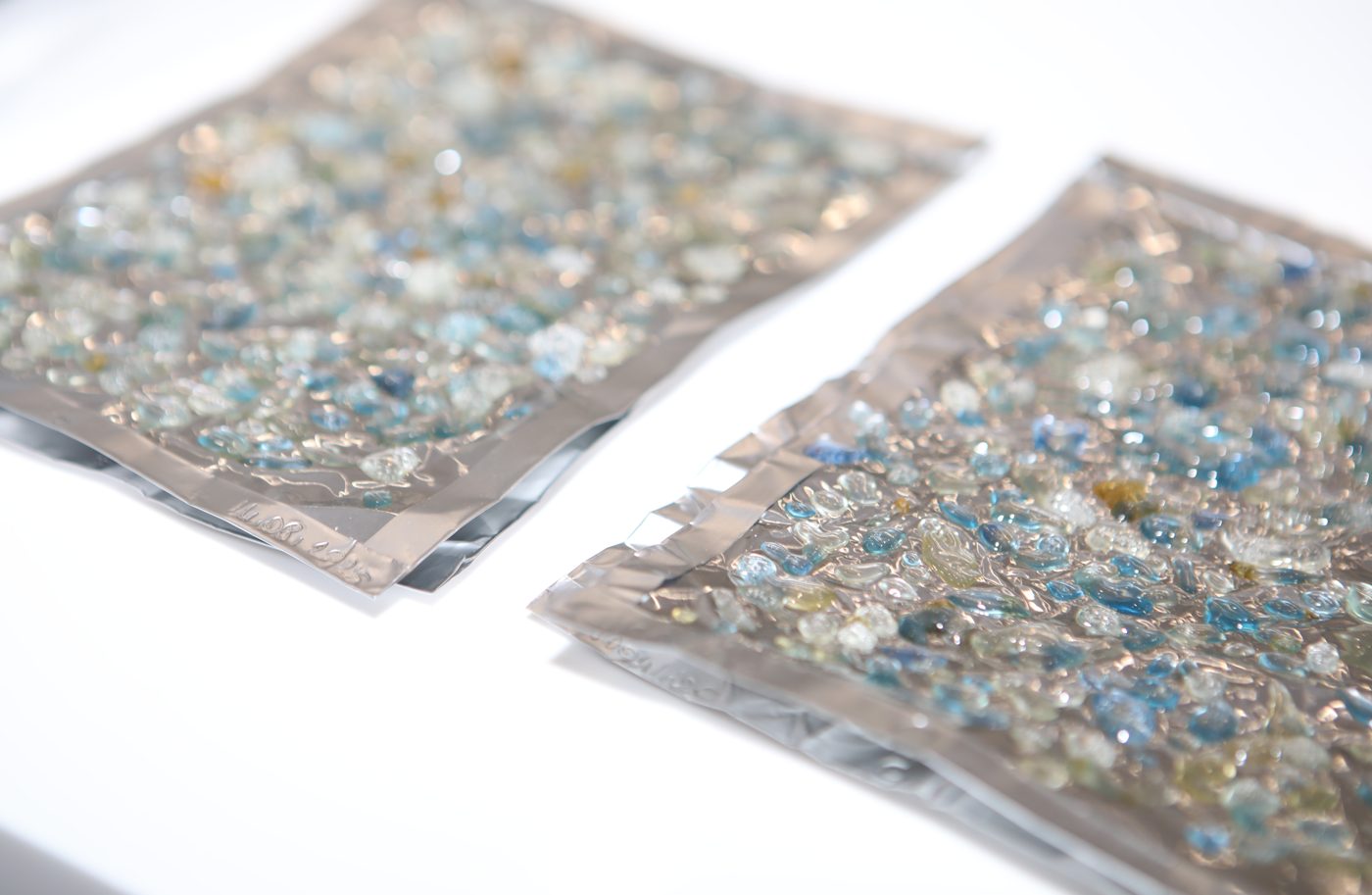
A label that fails these criteria can, on its own, raise the yellowness (b value) of an entire batch and push the material out of food-grade use. The Label material collected on the sorting lines is also recovered as a separate by-product within the recycling chain.
Coloured or Clear? The Third Decision
Clear and light blue bottles have the widest market because they can be coloured for any application. A coloured bottle may be recyclable, but its output is limited: green flake can only feed green production.
Colour is also a one-way street. Clear material can be tinted to any shade later, so it keeps every option open; a green or amber bottle has already spent that option at the design stage. This is the difference between a material with several possible buyers and one with a narrow list, and it shows up directly in the price a recycler can pay for the bale.
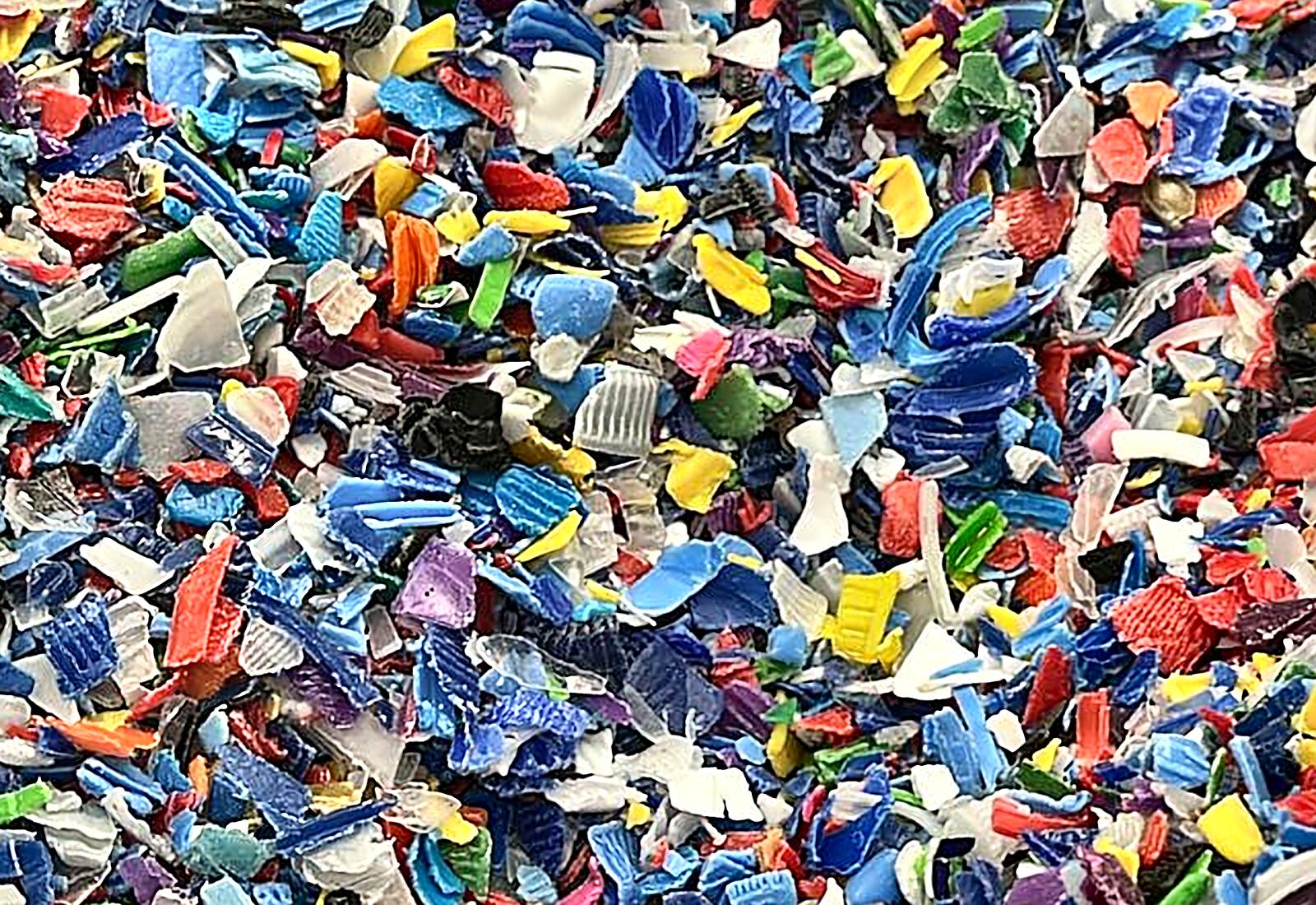
This is why sorting does not produce a single “recycled PET” output but separate streams heading to separate markets: high-purity PET Flakes, Mix Flakes for applications with no colour sensitivity, and Green Flakes for coloured production.
What Sorting Delivers Technically
At Doğa Pet’s Kırklareli plant this separation is performed by TOMRA sensor-based sorting systems. The result: 99.8% polymer purity, colour deviation below 0.5%. Daily capacity is 120 tonnes of PET flakes and 90 tonnes of rPET granules.
What those numbers mean: however good the sensor, it cannot fully compensate for a design fault in the input. High purity is the product of well-designed packaging and good sorting — not their sum.
The Commercial Cost of a Design Fault
These decisions look like technical detail but land directly on yield. A sleeve label that will not separate, or a high-density liner, lowers the acceptable share of the bale; as the contaminant ratio rises, the line stops more often and wash chemical and energy consumption climb.
More critically: when the food-grade certification threshold cannot be met, the material drops a tier into non-food applications. Depending on its design, the same bottle either enters the high-value bottle-to-bottle chain or stays in a low-margin industrial stream. That difference is settled long before the packaging reaches its shelf life — at the design stage.
There is a regulatory edge to this as well. With recycled-content thresholds now written into EU packaging rules, a brand that cannot source compliant material is not merely paying more; it has a compliance problem. Packaging designed to come apart cleanly is what keeps that material available and affordable, and the design decisions taken today are the ones that will be supplying the 2030 requirement.
Checklist for Brand Owners
- Are the cap and ring less dense than PET? (Prefer HDPE/PP.)
- Does the label detach in washing, and does the adhesive stay on the label?
- Is the sleeve, if you use one, in a floatable polymer rather than PETG?
- Can you use clear or light blue? Colour narrows the market.
- Direct printing, metallised film and full-coverage sleeves make sorting harder.
- Are barrier layers and additives declared, so the recycler can assess them in advance?
- Ask your supplier for batch-level specifications — our article on how rPET quality is measured explains the parameters.
For the full picture, see our recycling process and certificates.