








From Bale to Food-Grade rPET: Inside a PET Recycling Plant

Certificates say that a plant meets a standard. They do not show how. With the EU now writing the rules on how recycled content will be verified, including for material from outside the Union (see our analysis of the PPWR mirror clause), more buyers are asking to see the process itself. Here is what happens at our plant in Kırklareli between the bale and the big bag, stage by stage, with the records each stage leaves behind.
1. Bale intake and evaluation
Post-consumer PET bottles arrive in pressed bales from municipal collection, licensed collectors and, since 1 July 2026, the deposit return system. Each lot is weighed, sampled and graded before it is accepted: PET share by weight, colour mix, moisture, and the contaminants that matter most downstream, above all PVC, other polymers, metals and organic residue. Supplier, origin and grade of every bale are logged at this point. This is the first entry in the traceability chain, and the one an equivalence audit will look at first.
2. Pre-sorting: optical, mechanical and magnetic
Bales are opened and the stream passes through screens and magnetic separation before the sensor-based sorters. TOMRA near-infrared and colour units remove non-PET polymers, off-colour bottles and PVC; manual quality control on the line catches what sensors miss. The result is a clear and light-blue PET stream with polymer purity of 99.8% and colour deviation below 0.5%. Sorted-out caps and labels do not go to waste: they become our HDPE cap, label and polypropylene by-products.
3. Grinding and hot wash
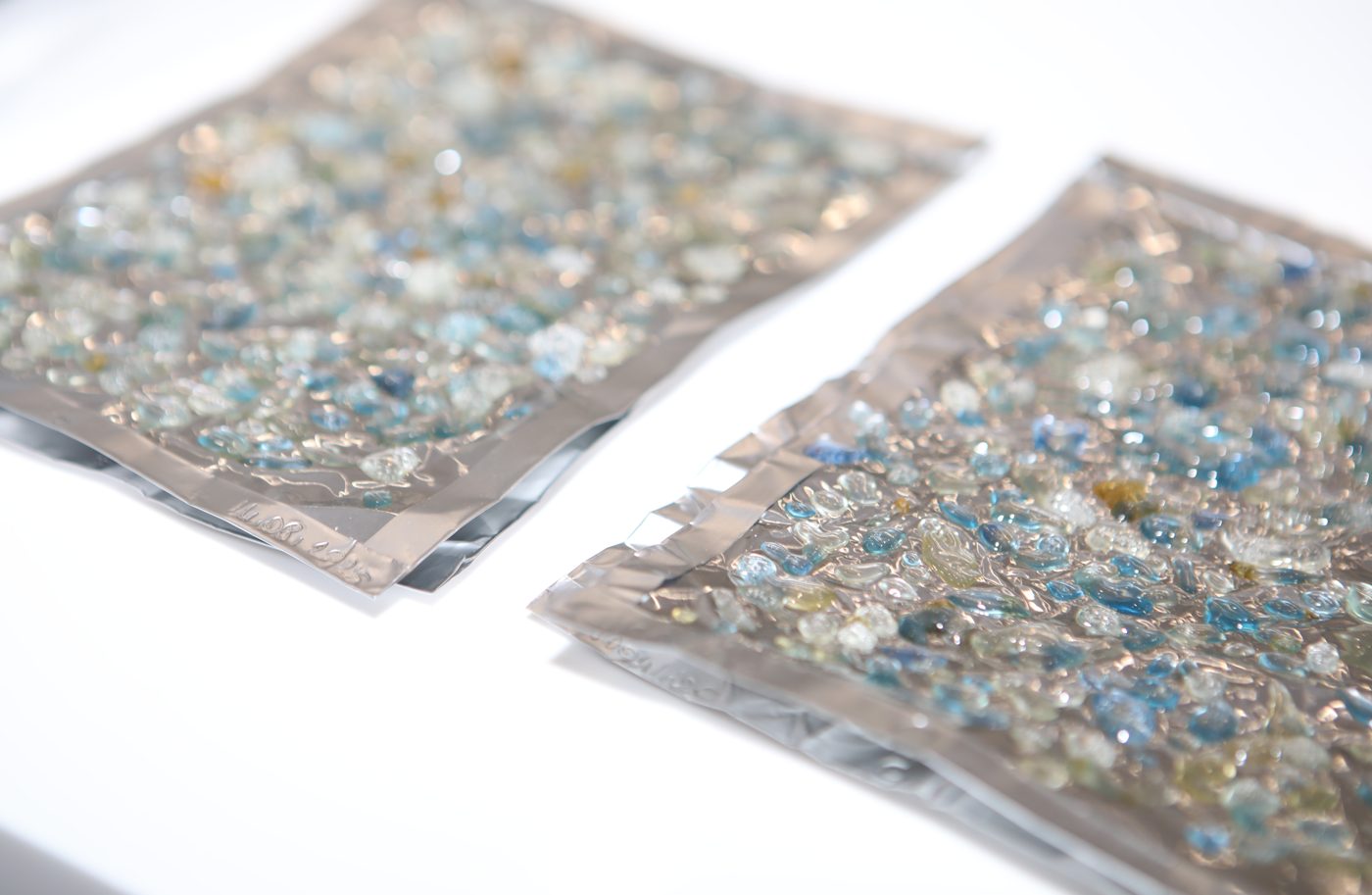
Sorted bottles are ground into flakes and washed on a hot wash line. Heat and friction remove glue, label residue and food remains; float-sink separation takes out the remaining polyolefins, which are lighter than water; rinsing and drying stages follow. Purity is measured again at the end of the line, and Flake Scan optical inspection in the laboratory checks for coloured and contaminated flakes before a lot is released.
4. PET flake: the first product
This is where “PET flake” as a commercial product begins. Hot-washed clear and light-blue flake leaves the line at a capacity of 120 tonnes per day, more than 40,000 tonnes a year. Part of it is packed in big bags for sheet and fibre customers (Flake, technical data sheet here); the rest is fed straight into our own extrusion lines. Colour-separated streams become green flake and mix flake.
5. Extrusion, filtration and SSP
Flake is dried, melted and filtered on two Starlinger recoSTAR PET 165 HC iV+ lines with a combined output of 3.6 tonnes per hour. Melt filtration removes the last solid particles; the pelletised material then goes through solid-state polycondensation (SSP), where hours under vacuum and heat raise the intrinsic viscosity back to bottle grade and drive off volatile contaminants. This decontamination step is what allows the granulate to comply with Regulation (EU) No 10/2011 and Regulation (EU) 2022/1616 for food contact. Two grades leave the SSP: rPET Resin FG for bottle-to-bottle and food packaging, and rPET Resin NFG for sheet, strapping and textile applications. Granulate capacity is 90 tonnes per day, around 24,000 tonnes a year.
6. Laboratory release and packing
No lot ships without a batch report: intrinsic viscosity, moisture, bulk density, colour (L*a*b*) and contamination counts, measured in our laboratory as described in How Is rPET Quality Measured?. Granulate is packed in big bags, labelled with its lot number and stored under cover until loading. The data sheets for the two granulate grades are available here: rPET Resin FG and rPET Resin NFG.
The documents that leave with the material
Read as a paper trail, the six stages produce intake records for every bale, sorting and wash-line logs, batch laboratory reports, the certificates of analysis that travel with each delivery, and the plant-level certificates: EFSA and FDA for the food-contact process, GRS for recycled-content chain of custody (see our certificates). That is the same set of evidence the associations pushing for a strict mirror clause say a third-country plant should be able to show: documented input origin, an audited process and an annual third-party certificate.
Why it matters in 2026
European PET recycling capacity is shrinking and imports are under scrutiny, so buyers are right to ask harder questions about non-EU material. The answer we prefer to give is a visit. Kırklareli is less than 100 km from the Bulgarian border, so road freight to Germany, Italy or Spain is a matter of days, and a plant tour is a short detour from the route. If you want the process behind a certificate, get in touch for a tour or a sample with its full batch record. The short version of the process is on our recycling process page.