










The Carbon Maths Behind Every Tonne of rPET
Sustainability reports are full of percentages. Procurement contracts are not — they deal in tonnes. So it is worth converting the most common claim about recycled PET into the unit that actually gets bought and sold.
The number behind the percentage
Life-cycle assessments carried out under ISO 14044 consistently place virgin PET at roughly 2.15 kg CO₂e per kilogram of resin, covering feedstock extraction through to polymerisation. Mechanically recycled PET, measured from bottle collection through sorting, washing, processing and granulation, comes in near 0.45 kg CO₂e per kilogram.
The difference is about 1.7 kg CO₂e saved for every kilogram substituted — a reduction of roughly 79%. Newer facility-level studies report figures as favourable as 87%, depending on energy mix and transport distance. The direction never reverses; only the size of the gap moves.
Scaled to a tonne, and then to a year
At 1.7 kg per kilogram, every tonne of virgin resin replaced by rPET avoids approximately 1.7 tonnes of CO₂e. Applied to our annual granulate output of over 24,000 tonnes, that is on the order of 40,000 tonnes of CO₂e avoided per year — provided the material actually displaces virgin resin rather than being downcycled into an application that would otherwise have used no polymer at all.
That caveat matters and is often skipped. The saving is a substitution saving. It is only real where the recyclate replaces virgin material one-for-one, which is precisely why bottle-grade quality is an environmental question as much as a technical one, not merely a commercial preference.
Where the remaining 0.45 kg comes from
Recycling is not free of emissions. The residual footprint sits mostly in three places:
- Collection and transport — kilometres between the collection point and the plant.
- Washing — hot caustic wash lines are thermally intensive.
- Extrusion and solid-state polycondensation — raising intrinsic viscosity back to bottle grade takes energy.
Two of those three are addressable by how a plant is built and powered, which is the part a recycler controls.
What we do about it
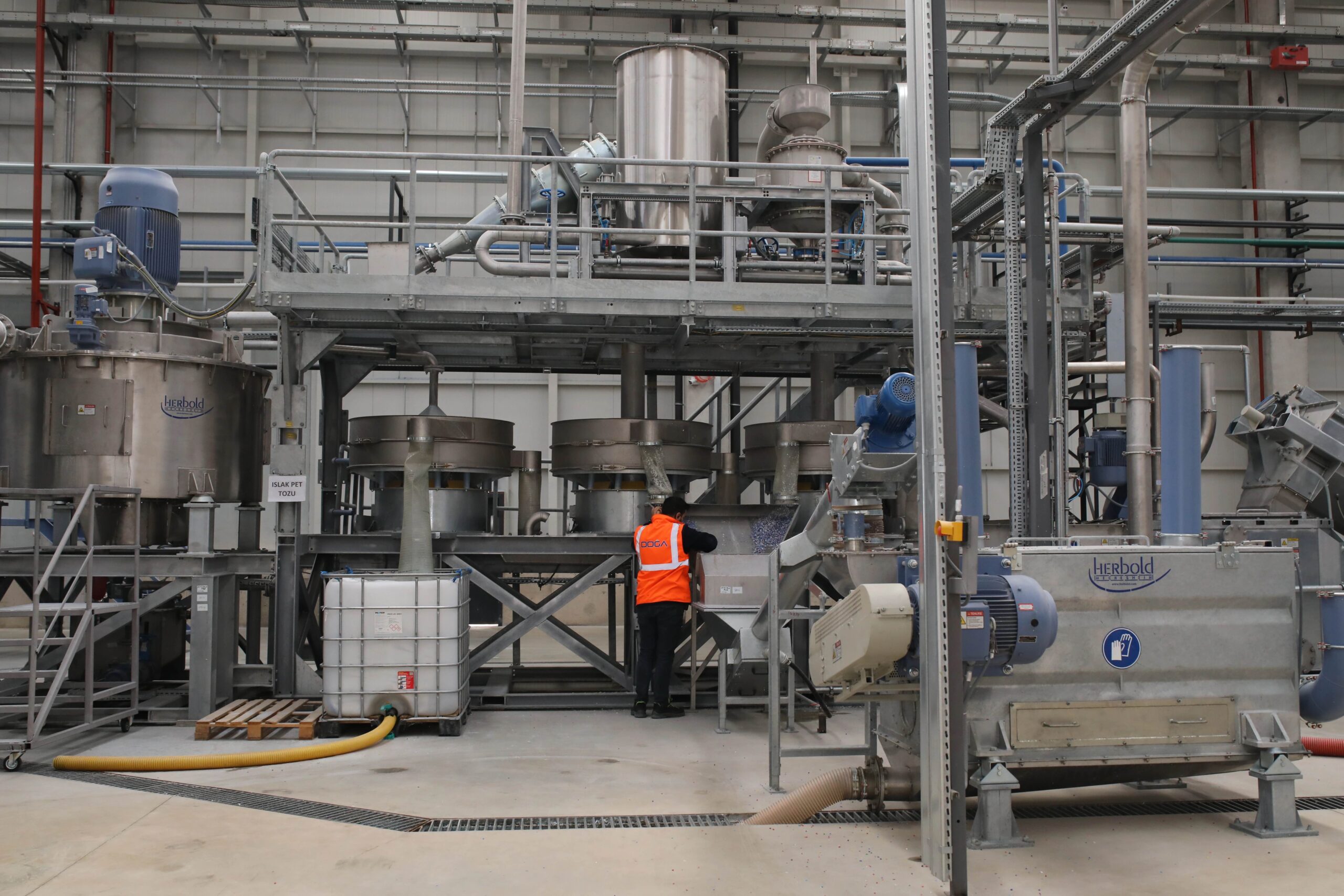
Our Kırklareli facility runs two Starlinger recoSTAR PET 165 HC iV+ lines at 3.6 tonnes per hour, giving roughly 28,000 tonnes a year of bottle-grade granulate. Choosing modern SSP technology is itself an emissions decision: older lines reach the same intrinsic viscosity target with materially more energy per tonne.
On the supply side, our solar power plant in Şanlıurfa Viranşehir addresses the electricity component directly rather than through offsets purchased after the fact.
Input quality does the rest. TOMRA sensor-based sorting holds polymer purity at 99.8% with colour deviation under 0.5%, which reduces the reprocessing and rejection that quietly inflate the footprint per saleable tonne. Material that has to be run twice carries twice the process emissions. Our rPET Resin FG and rPET Resin NFG both come out of that stream, alongside the flake sold directly to converters.
Using the figure honestly
If you are building a Scope 3 claim on recycled content, three points keep it defensible:
- Use supplier-specific data where you can. Generic averages are a starting position, not evidence.
- State the boundary. A cradle-to-gate figure and a cradle-to-grave figure are not interchangeable.
- Do not double-count. Flake and granulate from the same plant are sequential stages of one process; adding their savings together inflates the result.
The carbon case for rPET is strong enough that it does not need help. It needs a boundary, a source, and a tonnage — and then it survives an audit.